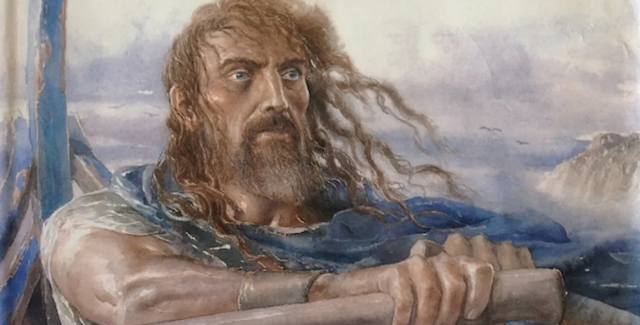
Odysseus to Telemachus
By Joseph Brodsky
Translated by Joseph Brodsky
My dear Telemachus,
The Trojan War
is over now; I don't recall who won it.
The Greeks, no doubt, for only they would leave
so many dead so far from their own homeland.
But still, my homeward way has proved too long.
While we were wasting time there, old Poseidon,
it almost seems, stretched and extended space.
I don't know where I am or what this place
can be. It would appear some filthy island,
with bushes, buildings, and great grunting pigs.
A garden choked with weeds; some queen or other.
Grass and huge stones . . . Telemachus, my son!
To a wanderer the faces of all islands
resemble one another. And the mind
trips, numbering waves; eyes, sore from sea horizons,
run; and the flesh of water stuffs the ears.
I can't remember how the war came out;
even how old you are--I can't remember.
Grow up, then, my Telemachus, grow strong.
Only the gods know if we'll see each other
again. You've long since ceased to be that babe
before whom I reined in the plowing bullocks.
Had it not been for Palamedes' trick
we two would still be living in one household.
But maybe he was right; away from me
you are quite safe from all Oedipal passions,
and your dreams, my Telemachus, are blameless.
Notes:
Poseidon: God of the sea. He despised Odysseus for blinding his son, the Cyclops Polyphemus, and constantly hampered his journey home by unusually stretching it.
Grunting Pig: On return, Odysseus's men become stranded on Circe’s Island, Aeaea, where Queen Circe, The beautiful witch-goddess, turns a portion of the crew into, “great grunting pigs.” In the epic poem, the men remain on her island for over a year during which they spend their time feasting and drinking. Odysseus remains unaffected by her spell and eventually compels Circe, through means provided to him by Hermes, to return the men to their original forms. This conclusion is yet to occur at this point in the poem and Odysseus seems to be close to desperation.
Palamedes: Palamedes was the son of Nauplius and Clymene in Greek mythology. He was one of the participants of the Trojan War on the side of Greece. After Helen had been kidnapped by Paris, the Oath of Tyndareus was invoked, according to which all previous suitors of Helen should defend the couple in any future setback. Odysseus had also taken the oath, but did not want to take part in the war, because an oracle had told him it would take him decades to return to his family. Agamemnon sent Palamedes in order to get Odysseus; when he arrived in Ithaca, Odysseus pretended to be insane by plowing bullocks in his fields. Palamedes realised that this was a trick and put Odysseus' infant son Telemachus in front of the plow. Odysseus, unable to kill his son, revealed his trick and was forced to join the Greek army. Odysseus always remembered that it was Palamedes who forced him to participate in the Trojan War.
Joseph Brodsky (1940-1996) came to the United States in 1972, an involuntary exile from the Soviet Union. He received the Nobel Prize in Literature in 1987 and served as Poet Laureate of the United States in 1991 and 1992.
The poem begins with the speaker, the epic hero Odysseus, addressing his son, Telemachus. Odysseus begins by telling his son that the Trojan War is now over. Although it was a history-defining war, the conclusion, and victor, seem unimportant to Odysseus. He came to the war against his will, stayed for its ten-year duration, and is finally on his way home. This piece, directed to his son, serves as a letter of sorts. It informs Telemachus of what happened to his father and how he has been changed by what he saw. He blames Poseidon for extending his journey. Odysseus feels that collusion of time and space has augmented his subjective sense of being away from home.
Odysseus literally does not remember the war; perhaps he does not want to remember. In either case he is othering his own side by referring to the Greeks as an autonomous “they” while the outcome of the war becomes nebulous compared with the death it incurs. In the world Brodsky creates for Odysseus, even the politically charged divinities of the Greek pantheon hold little meaning compared with the loss of family. Brodsky’s Odysseus cannot recall who won the war, though he deduces that the Greeks did as “only they would leave / so many dead so far from their own homeland.” Here readers familiar with The Odyssey know that the Greeks not only won the war, but that Odysseus was largely responsible for their victory by designing the infamous Trojan horse.
In the second stanza, Odysseus laments his hazy memory and his confusion regarding his location. He passionately tells his son that he has been wandering so long that all the islands look the same. The monotony of his journey has numbed him and made his eyes sore from staring at the “sea horizons.” The final lines of this section thus show an intimate emotional side of Odysseus that is not shared in the epic poem. As mentioned in my note, Odysseus’s reference to “some filthy island, / with bushes, buildings, and great grunting pigs” (where he feels utterly disoriented) alludes to the island of Circe where Odysseus’s men were changed into swine. Here Odysseus describes the enchantress Circe—later his lover for a year, and in many myths the mother of his son Telegonus—as “some queen or other,” at once rendering her anonymous and inconsequential.
In the final stanza, Odysseus looks to the future by bidding his son farewell. He predicts that he will not be able to make it home and so as a way of saying goodbye he has crafted this narrative. He tells his son to “Grow up…grow strong. Odysseus here begins to doubt his role as a father. Such doubts, however, are in the end what attest to his humanity, making the ramifications of his 20-year absence all the more moving. Perhaps due to his absence, the fatherless Telemachus didn’t have to encounter any Oedipal passions.
“Away from me,” he tells his son, “you are quite safe
from all Oedipal passions. / And your dreams, my Telemachus, are blameless”
Odysseus to Telemachus” examines the corruptive effects of empire on the individual. Often developing a tension between Homer’s cunning Odysseus and Brodsky’s own vision of the man as quietly introspective, the poem never addresses government directly. Instead, by humanizing Odysseus and his poignant separation from his son, Telemachus, the poem treats exile as a devastating consequence of power.
With a dropped line of direct address, this ode acts as both a personal poem and an epistle to Telemachus, for Odysseus is still not home. The poem employs irony, reiteration, and allusion to treat the theme of exile, all characteristic of Brodsky’s work (Brodsky lived in exile for many years). For example, in the first stanza irony is used to distance Odysseus from his status as a Trojan War hero.
I think this poem about exile is quite personal and poignant without any self-pity.
.