Monday, January 31, 2022

NOVEMBER 3RD


NOVEMBER 3RD

By Miyazawa Kenji

Translated by M A K O T O  U E D A


neither yielding to rain

nor yielding to wind

yielding neither to

snow nor to summer heat

               with a stout body

                                 like that

without greed

never getting angry

always smiling quietly

eating one and a half pints of brown rice

   and bean paste and a bit of

                             vegetables a day

in everything

not taking oneself

                     into account

                 looking listening understanding well

and not forgetting

living in the shadow of pine trees in a Weld

in a small

           hut thatched with miscanthus

if in the east there’s a

                    sick child

going and nursing

                             him

if in the west there’s a tired mother

going and carrying

                   for her

                   bundles of rice

if in the south

               there’s someone

                              dying

going

        and saying

            you don’t have to be

                 afraid

if in the north

          there’s a quarrel

                           or a lawsuit

saying it’s not worth it

                                  stop it

in a drought

              shedding tears

in a cold summer

             pacing back and forth lost

called

            a good-for-nothing

                           by everyone

neither praised

nor thought a pain

                 someone

                                   like that

is what I want

                           to be

(1931)


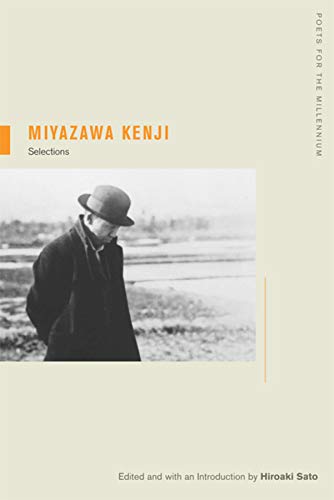
The Japanese poet Miyazawa Kenji, who died in 1933 at the age of thirty-seven, became a culture hero on the strength of a single brief poem written toward the end of his obscure and voluntarily impoverished life. “November 3rd”—an unpublished notebook entry probably intended more as a prayer than a poem—sketches a portrait of an idealized ascetic.

“November 3rd” remains universally familiar in a way that no poem has in the West since Rudyard Kipling’s “If ” or Joyce Kilmer’s “Trees.” The world it evokes, a world of thatched huts and drought-stricken Welds, sickly children and rice farmers with bent backs, might appear anachronistic when set against the Japan of computer graphics and advanced robot technology—unless you were to take a bus into the mountains and see landscapes and faces lifted intact from a Miyazawa poem.

In his own way Miyazawa came quite close to realizing the saintly ideal set forth in “November 3rd.” The son of a pawnbroker in northern Japan’s Iwate Prefecture (a backward region affected with chronic crop failures), he converted in adolescence to the Nichiren sect of Buddhism. Taking as his guide the Lotus Sutra, which teaches the availability of Buddhahood to all sentient beings, he dedicated himself to the welfare of the local farmers, becoming a sort of one man cultural and agricultural missionary, teaching crop rotation and soil improvement and exploring methods of food and drought prevention. In the meantime, he strictly observed vegetarianism, often subsisting on a poorer diet even than the local people were used to, and as a result he ruined his health and ultimately died of Pneumonia.


Saturday, January 22, 2022

Odysseus to Telemachus


Odysseus to Telemachus

By Joseph Brodsky

 
Translated by Joseph Brodsky


My dear Telemachus,
                   The Trojan War
is over now; I don't recall who won it.
The Greeks, no doubt, for only they would leave
so many dead so far from their own homeland.
But still, my homeward way has proved too long.
While we were wasting time there, old Poseidon,
it almost seems, stretched and extended space.

I don't know where I am or what this place
can be. It would appear some filthy island,
with bushes, buildings, and great grunting pigs.
A garden choked with weeds; some queen or other.
Grass and huge stones . . . Telemachus, my son!
To a wanderer the faces of all islands
resemble one another. And the mind
trips, numbering waves; eyes, sore from sea horizons,
run; and the flesh of water stuffs the ears.
I can't remember how the war came out;
even how old you are--I can't remember.

Grow up, then, my Telemachus, grow strong.
Only the gods know if we'll see each other
again. You've long since ceased to be that babe
before whom I reined in the plowing bullocks.
Had it not been for Palamedes' trick
we two would still be living in one household.
But maybe he was right; away from me
you are quite safe from all Oedipal passions,
and your dreams, my Telemachus, are blameless.

Notes:

Poseidon: God of the sea. He despised Odysseus for blinding his son, the Cyclops Polyphemus, and constantly hampered his journey home by unusually stretching it.

Grunting Pig: On return, Odysseus's men become stranded on Circe’s Island, Aeaea, where Queen Circe, The beautiful witch-goddess,  turns a portion of the crew into, “great grunting pigs.” In the epic poem, the men remain on her island for over a year during which they spend their time feasting and drinking. Odysseus remains unaffected by her spell and eventually compels Circe, through means provided to him by Hermes, to return the men to their original forms. This conclusion is yet to occur at this point in the poem and Odysseus seems to be close to desperation.

Palamedes: Palamedes was the son of Nauplius and Clymene in Greek mythology. He was one of the participants of the Trojan War on the side of Greece. After Helen had been kidnapped by Paris, the Oath of Tyndareus was invoked, according to which all previous suitors of Helen should defend the couple in any future setback. Odysseus had also taken the oath, but did not want to take part in the war, because an oracle had told him it would take him decades to return to his family. Agamemnon sent Palamedes in order to get Odysseus; when he arrived in Ithaca, Odysseus pretended to be insane by plowing bullocks in his fields. Palamedes realised that this was a trick and put Odysseus' infant son Telemachus in front of the plow. Odysseus, unable to kill his son, revealed his trick and was forced to join the Greek army. Odysseus always remembered that it was Palamedes who forced him to participate in the Trojan War.

Joseph Brodsky (1940-1996) came to the United States in 1972, an involuntary exile from the Soviet Union. He received the Nobel Prize in Literature in 1987 and served as Poet Laureate of the United States in 1991 and 1992.

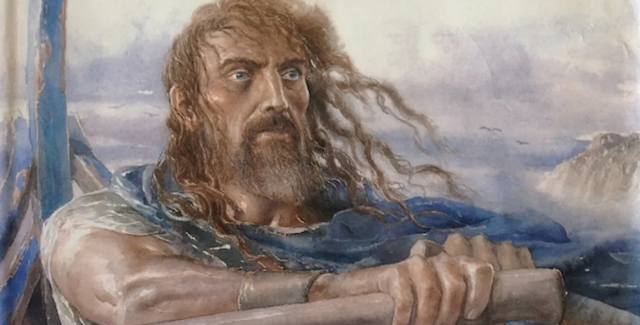
The poem begins with the speaker, the epic hero Odysseus, addressing his son, Telemachus. Odysseus begins by telling his son that the Trojan War is now over. Although it was a history-defining war, the conclusion, and victor, seem unimportant to Odysseus. He came to the war against his will, stayed for its ten-year duration, and is finally on his way home. This piece, directed to his son, serves as a letter of sorts. It informs Telemachus of what happened to his father and how he has been changed by what he saw. He blames Poseidon for extending his journey. Odysseus feels that collusion of time and space has augmented his subjective sense of being away from home.

Odysseus literally does not remember the war; perhaps he does not want to remember. In either case he is othering his own side by referring to the Greeks as an autonomous “they” while the outcome of the war becomes nebulous compared with the death it incurs. In the world Brodsky creates for Odysseus, even the politically charged divinities of the Greek pantheon hold little meaning compared with the loss of family. Brodsky’s Odysseus cannot recall who won the war, though he deduces that the Greeks did as “only they would leave / so many dead so far from their own homeland.” Here readers familiar with The Odyssey know that the Greeks not only won the war, but that Odysseus was largely responsible for their victory by designing the infamous Trojan horse.

In the second stanza, Odysseus laments his hazy memory and his confusion regarding his location. He passionately tells his son that he has been wandering so long that all the islands look the same. The monotony of his journey has numbed him and made his eyes sore from staring at the “sea horizons.” The final lines of this section thus show an intimate emotional side of Odysseus that is not shared in the epic poem.  As mentioned in my note, Odysseus’s reference to “some filthy island, / with bushes, buildings, and great grunting pigs” (where he feels utterly disoriented) alludes to the island of Circe where Odysseus’s men were changed into swine. Here Odysseus describes the enchantress Circe—later his lover for a year, and in many myths the mother of his son Telegonus—as “some queen or other,” at once rendering her anonymous and inconsequential.

In the final stanza, Odysseus looks to the future by bidding his son farewell. He predicts that he will not be able to make it home and so as a way of saying goodbye he has crafted this narrative. He tells his son to “Grow up…grow strong. Odysseus here begins to doubt his role as a father. Such doubts, however, are in the end what attest to his humanity, making the ramifications of his 20-year absence all the more moving. Perhaps due to his absence, the fatherless Telemachus didn’t have to encounter any Oedipal passions. 


“Away from me,” he tells his son, “you are quite safe
from all Oedipal passions. / And your dreams, my Telemachus, are blameless”

Odysseus to Telemachus” examines the corruptive effects of empire on the individual.  Often developing a tension between Homer’s cunning Odysseus and Brodsky’s own vision of the man as quietly introspective, the poem never addresses government directly. Instead, by humanizing Odysseus and his poignant separation from his son, Telemachus, the poem treats exile as a devastating consequence of power.


With a dropped line of direct address, this ode acts as both a personal poem and an epistle to Telemachus, for Odysseus is still not home. The poem employs irony, reiteration, and allusion to treat the theme of exile, all characteristic of Brodsky’s work (Brodsky lived in exile for many years). For example, in the first stanza irony is used to distance Odysseus from his status as a Trojan War hero. 


I think this poem about exile is quite personal and poignant without any self-pity.
.


Thursday, September 16, 2021

BOY BEHIND A WINDOW


BOY BEHIND A WINDOW

By Luis Cernuda

Translated by Hardie ST. Martin

As evening comes down, the boy
Buried in thought behind the glass
Watches it rain. The glow from a burning
Stretlamp makes the white rain
Stand out against the darkened air.

The room he has to himself
Wraps him in its warmth
And the thin curtain, guarding
The window like a cloud, whispers to him
That the moon has things under a spell.

School fades from his mind. This is
A break for him, with the book
Full of stories and pictures
Under the study lamp, the light,
Sleep, hours that weigh nothing.

The boy is living in the heart
Of his small power, with no desires
So far, no memories, never suspecting
That time waits out there,
With life, ready to spring.

The pearl is taking form in its shadow.


Born in Seville in 1902, LUIS CERNUDA was part of what came to be known in Spain as the Generation of 1927, which included Garcia Lorca, Rafael Alberti, and Vicente Aleixandre. Of these poets, Cernuda was the most cosmopolitan, totally familiar with European and American literary traditions. It was he who introduced the work of more recent English and American poets into Spanish poetry.

Although not so well known to readers of modern poetry in Spanish as other members of the Generation of ’27, Cernuda, as a poet if not as a person, has always been highly esteemed. His poetry is unabashedly direct. In a sense, almost all his poetry can be read as a soliloquy, even when the speaker seems to be addressing others. A maniacally self-absorbed individual, Cernuda wrote to discover himself, to justify himself and to console himself. He derived some consolation from the beauty of the natural world and from music and painting. He was a profoundly alienated character, alienated socially and, in a sense, alienated even from his own body. He was haunted by the image of a lost childhood paradise, like in the above poem, a paradise from which he was cast out by his sexual orientation and by a concomitant introversion. The moments of epiphanic transcendence which occur in his poems are of reunion with a whole, uninhibited self.

How beautifully the poet has conceived the bliss of childhood with no memories (and its associated pain or sweetness)! The life ready to spring seems ominous like the attack of everything waiting to spoil his innocence. Perhaps, after a lot of rubbing in the shadows, we too may turn out to be pearls.

Source: Roots& Wings: Poetry from Spain


Saturday, August 28, 2021

Brothers


Brothers 

By Giuseppe Ungaretti

Translated by Patrick Creagh

 What regiment are you from
 brothers?

 Word trembling
 in the night

 A leaf barely born

 In the racked air
 involuntary revolt
 of man face to face with his own
 fragility

 Brothers


Ranked by T.S. Eliot as “one of the very few authentic poets” of the last century and by Allen Tate as akin to Paul Valery in his sensitivity, Giuseppe Ungaretti wrote verse that was marked by simple vocabulary, unusual lyric tension and illuminating images.

A literary minimalist, Giuseppe Ungaretti is considered by some critics  the greatest Italian poet of the 20th Century. He served an infantryman on  the lower Isonzo front with the 3rd Army from 1915 until early 1918. In the  spring, he was transferred to the Western Front where Italian forces fought  with distinction. In his most famous war poem, RIVERS, he alludes to his  birth in Egypt, his youth in Tuscany and his service on both fronts during  the Great War. Ungaretti's pure style was achieved by  condensation to essentials and is in the tradition of the French Symbolists. 

The above poem conjures a situation with marvelous economy, far beyond the wordy poetic norms of the day. Columns of infantry swap greetings as they file past each other. These words hang in the air, defying the silence and the risk of drawing enemy fire as new leaves uncurl despite the risk of frost, and as his own words unfurl despite artillery and barbed wire.

These tiny affirmations of shared humanity and common purpose, involuntary because instinctive, hinge on the title-word ‘brothers’, so rich in meaning for the poet. Politicians and demagogues boasted that the war was bonding Italians together for the first time. Ungaretti lived that process with a rare intensity.

The poet, in the trenches during WW1, grasps the very core of humanity and Communication in this short verse. He transcends the horror of the trenches and reaches out, letting the spoken word carry his mixture of anxiety, isolation and hope, through darkness and hell, searching for signs of life that can turn out to be a fellow soldier or enemy. His symbolism seems to me so genial; I cannot dissect it or describe it closer. It just grips me, esp the final pleading repletion of ‘Brothers’. On the war front there aren’t friends or enemies, winners or losers, but only BROTHERS.  This is the key word that stands out in the second and last verses and in the title.

In this distressing scenario, the individual rediscovers human solidarity, which originates from that feeling of brotherhood that levels all men, making them equal and united regardless of which trench, army, or country one belongs.


Monday, July 19, 2021

Supersonic Death


Supersonic Death 
 
by Nicanor Parra
 
Translated by Liz Werner

zooms by at high speed
in the direction of the old folks’ home
without paying any attention to me
as if I were a red-lipped teenager
when death knows full well I’m her fiance
and all I do these days is yawn

evasive death—indifferent death
you are the biggest flirt of all

Source: Antipoems by Nicanor Parra

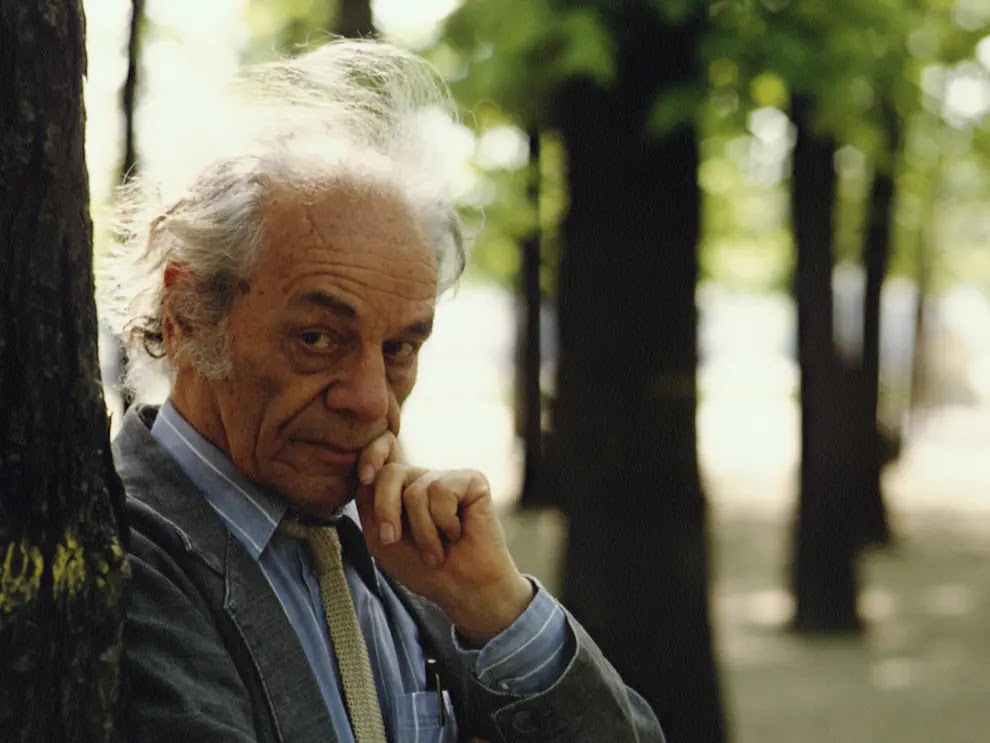
“Real seriousness," Nicanor Parra, the antipoet of Chile, has said, rests in "the comic. He was one of the most important Latin American poets of his time, the originator of so-called antipoetry (poetry that opposes traditional poetic techniques or styles}. He was a poet and an academic, a mathematician and a physicist, who gained international recognition for his anti-poetry." Pablo Neruda rated him as ” One of the great names in the literature of our language. “ Parra died at the age of 103 in 2018.

Another antipoem posted below is a valid reminder to many of the Facebook Poets 😊

To Young Poets


Young Poets Write as you will
In whatever style you like
Too much blood has run under the bridge
To go on believing That only one road is right.
In poetry everything is permitted.
With only this condition of course,
You have to improve the blank page.


Saturday, July 17, 2021

What Luck


What Luck

By Tadeusz Rozewicz

translated by Adam Czerniawski

What luck I can pick
berries in the wood
I thought
there is no wood no berries.
What luck I can lie
in the shade of a tree
I thought trees
no longer give shade.
What luck I am with you
my heart beats so
I thought man
has no heart.


This beautiful and affecting poem is about how we slowly come back to life and sense once again simple pleasures after a heartbreak in relationship.  Emerging from devastation, man (can be woman too) finds his way back into the world: woods, berries, trees, shades. The world that had been taken away is slowly returned. And then one day, your heart beats again. Beats in time to another's. What luck. What luck that you can return to the world.


Widely held to be the most influential Polish poet of a generation that includes Czeslaw Milosz and Wislawa Szymborska, Tadeusz Rózewicz gives voice in the sharpest, most disturbing way to the crisis of values that has plagued our civilization. 


Tom Paulin says the following about the poet in an afterword in the book I have.


“Rózewicz's poems have the clipped, intense feel of conversation in wartime. They are clandestine speech, wary phrases, oblique gestures, wry turns that stop, start, disappear like jammed radio signals. These are messages from the underground. Always in these poems the individual emotion seems not to be the possession of the writer so that each impersonal lyric appears clamped by something that is out there — history,politics, the metal sinews and coiled wires of the public world. He gives that grey void a voice, then turns that voice against, itself, against poet, reader, world.As he states in My Poetry, his poetry "loses even against itself. It hides "itself in itself" and explains nothing. 


Różewicz's poems were ascetic, without metre, rhyme or metaphors, stripped bare of any rhetorical posturing and ornamentation or anything that could be considered aesthetically pleasing. One result of this is that long before Barthes he creates what that critic terms "writing degree zero" — he designs "a non-style or an oral style" which is free from the frozen classical or romantic gestures of the printed word. His poems therefore have a tentative, throwaway, ephemeral, intensely vulnerable look to them— they seem to say "I'm like that bit of paper you see on the street.”


Monday, July 12, 2021

Buying


Buying
 
By JEAN FOLLAIN (1903-1971}
 
Translated by translated by Heather McHugh
 
She was buying an elixir
in a city
of bygone times
yet we should think of her
now when shoulders are as white
and wrists as fine
flesh as sweet
Oh, vertiginous life!
 
An opposition between once in the past and now, in this poem by French poet Jean Follain, begins with a thought about a woman who buys an elixir in a city hundreds or thousands of years ago. She was buying an elixir / in a city / of bygone times—Follain tells a story of a woman of an era which has been almost entirely erased. She indulges a cure, a power, that might as well be magic.Yet we should think of her / now when shoulders are as white / and wrists as fine / flesh as sweet—from the woman long ago buying an elixir, the poem suddenly crashes into the present. Her buying an elixir does not sound half as creepy as our thought of white shoulders, fine wrists, sweet flesh. She bought an elixir and had an appetite; we seem to be nothing but appetite. 
 
Her “Buying” is ultimately about trying to get some kind of reputation or fame in this ephemeral life. One can surmise this sets her apart from her fellow citizens, but what does it have to do with us? The word "elixir" is important because it has magical connotations. What if she were buying apple? We don't know anything about this woman; we receive no image of her, and yet our awareness that she lived, existed, liberates in us a feeling of closeness to her, in her flesh. A woman who died long ago becomes like our contemporary women. The poem conveys a very complex set of feelings about the frailty and transience of the body, which is precisely what makes our life "vertiginous."
 
There is a sense of mystery, enigma, and a rare luminous quality in his poem and that is what him one of my favourite French poets. The ‘concrete details’ in Follain’s poems include bowls with cracks in which sauce congeals, and baskets and buttons. Listing the repertoire of physical objects in the poems might suggest they are vintage sepia postcards: white stones, inky desks, hooks, spades, scythes, hoes, a ‘gap-toothed’ rake, a dog’s footprints in damp sand. But always what snags attention is movement: a squirrel hopping, a child sucking at its mother’s breast, a boy stooping to tie a shoelace, a girl scrabbling for a slipper under a wardrobe, a woman sewing by a window ,another rolling down her stockings, a man turning a key in a lock, another slicing off two fingers to avoid military service, a pin dropping to a floor that ‘no one has waxed’, apples rolling out of a sack, a wasp buzzing in a curtain’s fold, a pan of milk seething on a stove. His poems are more like snatches of a film than postcards, a film both documentary and fictional, like memory, and invariably in the present tense, which is when remembering happens.
 
The poetry of Jean Follain ( is increasingly seen, by poets and critics in France and by his foreign admirers, as central to French poetry’s change of course after Surrealism. He speaks of things outside himself; he admired his freedom from rhetoric. Follain’s short, down-to-earth, subtle poems, many of which set out to preserve the lost rural world of his pre-war Norman childhood, have influenced a new generation of French poets.