Tuesday, July 5, 2022

In Raspberry Season


 In Raspberry Season
By Rolf Jacobsen
Translated by Roger Greenwald

In raspberry season
the wasps come into the house
and can’t find their way out again; day after day
they dash against the windowpanes, sooma-sooma-soom
until we can sweep them out on the dustpan.

For you and me too
there are barriers we can’t understand.
Time after time we throw ourselves against something we
       cannot see
until they sweep us out one day on the dustpan.
Unless, by chance,
someone on this earth or in the clouds
raises a window so we get through.

Rolf Jacobsen was one of Norway’s greatest modern poets. Garnering the highest praise of critics, Jacobsen won many of Norway’s and Sweden’s most prestigious literary awards, including the Swedish Academy’s Dobloug Prize and the Grand Nordic Prize, also known as the “Little Nobel.” But he also has earned a wide popular audience, because ordinary readers can understand and enjoy the way he explores the complex counterpoint of nature and technology, progress and self-destruction, daily life and cosmic wonder.( from introduction by Roger Greenwald)

I loved the apt imagery with which the poet depicts a human situation. There are many barriers in our day to day life: bureaucracy, red tapism, caste, gender, nationality, social stigma etc apart from psychological and emotional barriers. Think of millions of ordinary people who beat against these barriers and seek help. Perhaps some good Samaritans or the Almighty will see our plight and open the doors for our salvation.

Roger Greenwald is a renowned American poet and an award winning translator of Scandinavian poetry.
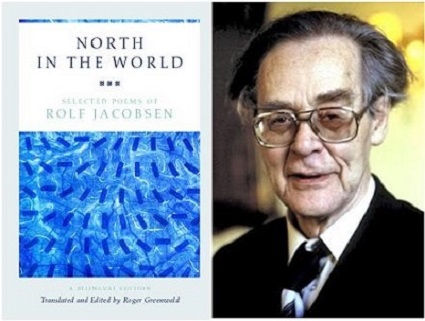


Source : Ref: North in the World: Selected Poems of Rolf Jacobsen - A Bilingual Edition. Translated and edited by Roger Greenwald. University of Chicago Press, 2002. ISBN 0-226-39035-7. Winner of the Lewis Galantière Award from the American Translators Association.

I really love you, believe me…

 May be art

I really love you, believe me…

Sheltering-in-place #1

 By Attila Jozsef (1905 -1937) Hungarian Poet

translated from Hungarian by John Batki

                        I really love you,

believe me.  It is something I inherited

from my mother.

She was a good woman.  After all,

she was the one who brought me

into this world.


                    We may compare life

to a shoe, or a laundromat,

or whatever.

Nonetheless, we love it

for reasons of our own.


                     Saviours, there are

enough of them to save the world

three times a day and still nobody knows

how to light a match.  I’ll have to give up

on them.


                     It would be nice

to buy tickets for a trip to the

self.  It must be somewhere inside us.


                    Every morning I wash

my thoughts

in cold water.

That way they come out fresh as a daisy.


                     Diamonds can sprout

good warm songs,

if you plant them under your heart.


                    Some people will stay

pedestrians no matter what they ride,

horse, car or airplane.


                    Me, I just lie around

in the morning song of larks

and still make it over the abyss.


                    Let us carefully save our

true souls

like our best suit of clothes

to keep them spotless for the days of

celebration.


Attila József was one of the greatest Hungarian poets of the 20th century

 József was attracted by Marxist ideology and became a member of the then-illegal Communist Party. When his first poems were published, he was tried for blasphemy. In his own poetry József presented intimate pictures of proletarian life. He immortalized his mother, a poor washerwoman, and made her a symbol of the working class. He created a style of melancholy realism, infused with irrationality, through which he was able to express the complex feelings of modern men and reveal his own faith in life’s essential beauty and harmony. At the age of 32 he committed suicide throwing himself under a train.

I fell in love with this poem while reading it yesterday in the book "Against Forgetting, Twentieth Century Poetry of Witness edited by Carolyn Forche. Attila Jozsef uses unusual and comically pedestrian analogies to compare life to 'to a shoe, or a laundromat'(coin-operated washing machines and dryers for public use). This is as if life is like something you buy in a store or a shoe you slip in and slip out or some clothes you wear and wash again. There are some lines that have a ring of truth like:

                     'Some people will stay

pedestrians no matter what they ride,

horse, car or airplane.'

 The poet here mocks about leaders and politicians(saviors) who promises but never delivers.

What is arresting in this poem is the tender and poignant last lines. While our life could really be a mess, our souls are something special to be worn on momentous occasions. This poem thus becomes a celebration of the soul within the self.


Monday, March 7, 2022

No More Clichés


No More Clichés
 
By Octavio Paz 
 
(Nobel Laureate, Former Mexican Ambassador to India. and one of the greatest poets of 20th Century) 
 
Beautiful face
That like a daisy opens its petals to the sun
So do you
Open your face to me as I turn the page.

Enchanting smile
Any man would be under your spell,
Oh, beauty of a magazine.

How many poems have been written to you?
How many Dantes have written to you, Beatrice?
To your obsessive illusion
To you manufacture fantasy.

But today I won't make one more Cliché
And write this poem to you.
No, no more clichés.

This poem is dedicated to those women
Whose beauty is in their charm,
In their intelligence,
In their character,
Not on their fabricated looks.

This poem is to you women,
That like a Shahrazade wake up
Everyday with a new story to tell,
A story that sings for change
That hopes for battles:
Battles for the love of the united flesh
Battles for passions aroused by a new day
Battle for the neglected rights
Or just battles to survive one more night.

Yes, to you women in a world of pain
To you, bright star in this ever-spending universe
To you, fighter of a thousand-and-one fights
To you, friend of my heart.
 
The speaker here (may be a bachelor) makes a contrast between womanly beauty as defined by the images found in magazines (a species of beauty to which Dante and his "successors" [the "many Dantes"] across the centuries have too often alluded and emphasized and the beauty defined by charm, intelligence, and character: not on "fabricated looks"). Beatrice's beauty is a passive beauty to be idealized, gawked at, and, in our own glamorized world, unfortunately emulated.
 
Shahrazade's beauty is surpassed by her skill as a storyteller—her charm, her intelligence, and her character (all implied through the allusion to Shahrazade as storyteller in Arabian Nights). Women should not be valued as objects of beauty, as is too often promoted in our culture's magazines. Women should be recognized as "fighter of a thousand-and-one fights" (pun referring to Arabian Nights), especially women "who are friend[s] of the heart"—not of the eye.
 
Happy Women's day to all  the women who more blessed with their inner beauty than outer.